CV & Career Advice · For job seekers
Changing Careers in the GCC: Repositioning Your Experience Without Starting Over
Career pivots are harder in title-driven markets — but not impossible. How to reframe experience, target bridge roles and price the transition honestly.
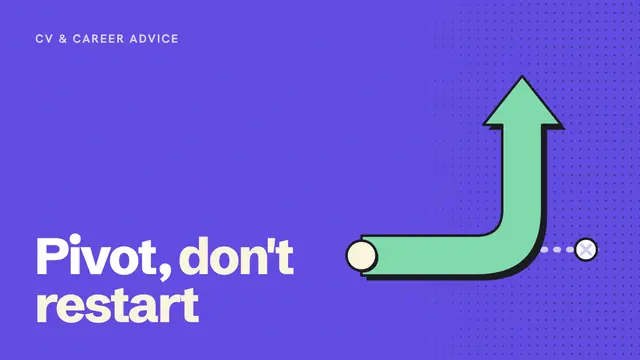
A GCC career change works through bridge roles: positions that value your existing domain knowledge while building the new skill set. Direct leaps between unrelated fields rarely clear screening; sequenced two-step pivots usually do.
On this page
Why direct leaps fail screening#
Screening — human or AI — matches evidence against requirements. With zero evidence in the target field, you lose to candidates who have it. The answer isn’t a cleverer CV; it’s choosing roles where your evidence counts.
The GCC adds a structural factor: employment visas are tied to roles and employers hire against immediate delivery, which narrows appetite for retraining bets compared with markets where a "potential hire" carries less overhead. This isn’t a reason to abandon a pivot — it is a reason to design one that never asks an employer to bet on zero evidence.
Find the bridge role#
Sales engineer between engineering and sales; operations in your current industry for a target company; consulting on your domain into a new sector. Bridges monetise what you know while you build what you don’t.
To find your bridge, decompose the move into its two dimensions — industry and function — and change one at a time. An accountant who wants product management in tech might first move to a finance role *in* a tech company (industry first), then transfer internally (function second). Internal transfers are the pivot’s secret weapon: once you’re inside and trusted, the evidence bar for a function change drops dramatically.
- Change industry first, function second (or vice versa) — never both at once.
- Look for hybrid titles: sales engineer, technical account manager, operations analyst, finance business partner.
- Internal transfers clear a far lower evidence bar than external applications.
Reframe, don’t rewrite#
Translate achievements into the target field’s language — process improvement, stakeholder management, revenue impact — and lead your CV with a summary that names the transition explicitly. Hiding it confuses; owning it persuades.
The summary formula for career changers: current strength + explicit direction + the connecting logic. "Supply-chain manager with eight years in FMCG distribution, moving into commercial operations — bringing forecasting, vendor negotiation and P&L discipline to revenue teams." A recruiter who understands your story in one paragraph can sell it; one who has to reverse-engineer it from job titles will file you under the old career.
Price the transition#
Pivots often mean a flat or modestly reduced package for one step, recovered within two. Decide what cut you’ll accept before interviewing, and weigh it against the ceiling of staying put.
Do the arithmetic over five years, not one: a 15% step down into a field with a higher trajectory frequently overtakes the old path by year three — while a "safe" stay in a plateaued career compounds its own quiet cost. Setting your acceptable-cut number before interviews also protects you in negotiation, where transition anxiety otherwise tempts career changers into underpricing themselves permanently.
Key takeaways
- Pivot in two steps through a bridge role, not one leap.
- Lead with an explicit transition summary on your CV.
- Translate achievements into the target field’s language.
- Budget for one flat step; recover within two.
Frequently asked questions#
Do certifications help a career change?
They help as evidence of commitment but rarely substitute for experience. Pair them with projects or bridge-role experience.
How do I answer "why are you changing careers" in interviews?
With a forward-looking, specific answer: what draws you to the new field and what evidence shows you’ll succeed. Avoid framing it as escape from the old one.
Sources and further reading#
Put this into practice
UAE Gratuity Calculator
UAE end-of-service gratuity worked to the legal formula, with the 24-month cap applied.
How to Spot and Avoid Recruitment Scams Targeting GCC Job Seekers
Fake job offers, fee-charging "agents" and identity-theft schemes target GCC job seekers daily. The red flags and the rules that keep you safe.
Published 10 October 2026. Read our editorial policy or report a correction.

Nas Talent Career Team
Career advisers covering CVs, interviews, offers and job searches in the GCC market.