Candidate Screening · For employers
Candidate Screening Methods Compared: CV Review, Assessments, AI and Interviews
What each screening method actually predicts, what it costs, and how to combine them into a funnel that filters fairly and fast.
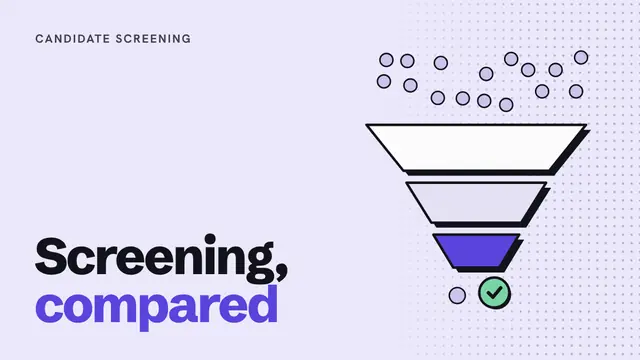
No single screening method predicts job performance reliably. Manual CV review is fast but inconsistent; structured assessments predict well but cost candidate goodwill; AI screening scales evidence-gathering; structured interviews remain the strongest final filter. The right design layers them.
On this page
Manual CV review: fast, cheap, inconsistent#
Two reviewers reading the same CV routinely disagree. Manual review works as a sanity check on a pre-ranked list, not as the primary filter for hundreds of applications.
The inconsistency is well documented: reviewer judgements shift with fatigue, order effects (the same CV scores differently at position 5 and position 155), and surface cues like formatting and university names that predict little. None of this makes human review worthless — it makes it a poor instrument for the high-volume top of the funnel, where its weaknesses are amplified by scale.
Skills assessments: predictive but costly in goodwill#
Work-sample tests are among the best predictors of performance, but every additional hour of unpaid assessment increases drop-off — especially for employed candidates. Reserve them for finalists.
Decades of selection research consistently place work samples and structured ability measures near the top for predictive validity. The practical constraint is the candidate’s side of the exchange: an employed professional weighing three opportunities will complete a two-hour exercise for a role they’re invested in, and abandon a four-hour take-home issued before anyone has spoken to them. Position assessments where mutual investment justifies them.
- Best predictors: work samples, structured ability tests, structured interviews.
- Weak predictors: unstructured interviews, years-of-experience counts, self-rated skills.
- Placement rule: the assessment’s demand on candidate time should match the stage’s mutual commitment.
AI screening: evidence at scale#
AI’s advantage is consistency: every application is read fully and scored against the same criteria, with evidence attached. It moves the human effort from reading CVs to reviewing ranked evidence.
Two cautions keep AI screening honest. First, it is only as good as the role brief — vague criteria produce confident-looking rankings of the wrong thing. Second, demand explainability: a system that can show "ranked #3 because: 6 years GCC channel sales, quota attainment stated for 3 consecutive years, Arabic/English bilingual" can be audited and corrected; a bare score cannot.
Structured interviews: the strongest final filter#
Unstructured "conversation" interviews predict little. Structured interviews — same questions, defined scoring — roughly double predictive validity and reduce bias.
Structure does not mean stiffness. It means every candidate faces the same core questions, every interviewer scores against written anchors ("what does a 4/5 answer contain?"), and scores are recorded before the panel discusses. The discussion still happens; it just starts from independent evidence instead of the most confident voice in the room.
A funnel that works#
AI-ranked screening for all applicants → recruiter validation calls for the top 10–15 → structured interviews for 4–6 → a focused work-sample for the final 2–3. Each stage earns the candidate’s time it asks for.
Instrument the funnel as you would a sales pipeline: conversion rate and elapsed days per stage. A stage that eliminates almost no one is not filtering and can be removed; a stage where strong candidates disappear is either too slow or asking too much too early. Most funnels have one of each, and fixing the pair is usually worth more than any single tool purchase.
Key takeaways
- Layer methods: AI for scale, humans for validation, structure for interviews.
- Put assessments late in the funnel to protect candidate goodwill.
- Structured interviews outperform unstructured ones by a wide margin.
- Consistency is the point — every candidate judged against the same evidence.
Frequently asked questions#
Should we test every applicant?
No. Testing hundreds of applicants signals disrespect for candidate time and increases drop-off. Test finalists only.
Can AI screening be audited?
Good systems show the evidence behind every score, making audits easier than reconstructing why a human rejected a CV.
What is the single cheapest improvement to screening quality?
Adding scoring anchors to interviews. It costs an afternoon of preparation and measurably improves both prediction and fairness.
Sources and further reading#
Put this into practice
5 AI recruitment options in the UAE (2026): 4 ATS platforms and 1 managed service
Managed recruitment services and applicant tracking systems for UAE and KSA hiring.
Manatal vs Zoho Recruit
Manatal wins on interface and AI matching; Zoho Recruit wins on price and ecosystem.
Published 10 October 2026. Read our editorial policy or report a correction.

Nas Talent Recruitment Team
Specialists covering candidate screening, sourcing and employer hiring challenges across the UAE and KSA.