Candidate Screening · For employers
Designing an Interview Process Candidates Don’t Drop Out Of
Every extra round loses candidates. How to design a loop that gathers real signal in two to three stages and respects working candidates’ time.
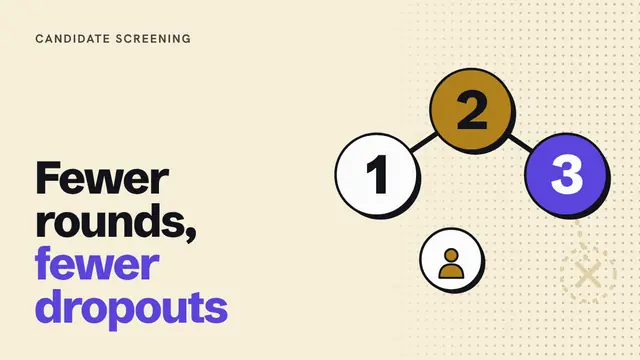
Two to three well-designed stages gather more reliable signal than five conversational rounds. Each stage should answer a defined question — can they do the work, will they do it here, do the terms fit — and the whole loop should complete inside three weeks.
On this page
Each round earns its place#
Before adding a round, name the question it answers that previous rounds don’t. "The VP wants to meet them" is a calendar problem, not a signal problem — fold it into an existing panel.
Audit your current loop with a simple exercise: list every round, and next to each write the decision it changed in the last five hires. Rounds that never changed a decision are pure cost — candidate time, interviewer time, elapsed days — and elapsed days are the currency competing offers are denominated in.
A three-stage template#
Stage 1: structured screen on evidence and expectations (30 min). Stage 2: capability deep-dive with a realistic work discussion or sample (60–90 min). Stage 3: team and terms — mutual evaluation plus offer alignment (45 min).
Each stage also has a selling job that is easy to forget: stage 1 should leave the candidate more interested than they arrived, stage 2 should show them the actual work and the people doing it, and stage 3 should resolve every question standing between them and a yes. Interviewing is bidirectional in a candidate-scarce market — panels that only extract information lose finalists to panels that also persuade.
- Stage 1 answers: does the evidence hold up, do expectations align? (30 min, video)
- Stage 2 answers: can they do this work at this level? (60–90 min, work-focused)
- Stage 3 answers: will they thrive here, and do the terms close? (45 min, team + decision-maker)
Respect employed candidates#
Most GCC candidates interview while employed. Offer early-morning and evening slots, video-first early rounds, and compress on-site requirements into one visit.
Small logistics carry outsized signal: a booking link instead of email chains, an agenda sent in advance with interviewer names, starting on time, and a named contact for questions. Candidates extrapolate from your process to your management culture — accurately, in most cases.
Kill the take-home creep#
Multi-day unpaid assignments filter for the unemployed, not the best. If a work sample matters, cap it at two hours or run it live in the interview.
Live collaborative exercises usually beat take-homes anyway: working through a realistic problem together for forty-five minutes shows reasoning, communication and coachability — three signals a polished document hides. If a take-home is unavoidable, scope it honestly, tell candidates the expected time budget, and have a human discuss their work rather than silently scoring it.
Key takeaways
- Three stages, each answering a defined question.
- Complete the loop within three weeks.
- Schedule around employed candidates’ constraints.
- Cap work samples at two hours.
Frequently asked questions#
How many interviewers should be involved?
Four to six across all stages is usually enough. Beyond that, feedback quality drops and scheduling drags.
Should rejected candidates get feedback?
Finalists deserve a call with genuine, specific feedback. Earlier-stage candidates deserve a prompt, respectful decision. Both practices measurably improve how your process is described to other candidates.
Sources and further reading#
Put this into practice
5 AI recruitment options in the UAE (2026): 4 ATS platforms and 1 managed service
Managed recruitment services and applicant tracking systems for UAE and KSA hiring.
Manatal vs Zoho Recruit
Manatal wins on interface and AI matching; Zoho Recruit wins on price and ecosystem.
Published 10 October 2026. Read our editorial policy or report a correction.

Nas Talent Recruitment Team
Specialists covering candidate screening, sourcing and employer hiring challenges across the UAE and KSA.